
Not All AI Agents Are Created Equal-Here’s How to Tell Them Apart
A plain-English guide to the types of AI agents, what makes each one different, and which one your business actually needs.
⏱ 7 min read
Somewhere between a LinkedIn scroll and a vendor demo, ‘AI agents’ became one of those phrases everyone says and almost nobody defines consistently. Gartner calls this ‘agent washing’-the rebranding of basic scripts and rule-based automations as intelligent agents in AI. Of the thousands of companies claiming to offer agentic AI, Gartner found only around 130 are building genuinely agentic systems.
That gap between marketing and reality is expensive if you can’t spot it. This post gives you a clear framework for understanding what AI agents actually are, how they differ from one another, and which type fits the problem you’re actually trying to solve.
Why Classification Matters: The Foundations of Computational Agents
The concept of a rational agent in AI -a system that perceives its environment and takes actions to maximize a defined objective – was formalized in research long before LLMs existed. What has changed is not the theoretical framework but the dramatic expansion of what agents can perceive, process, and act upon. Gartner maps the market progression clearly: embedded AI assistants in 2025, task-specific agents in 2026, collaborative multi-agent AI ecosystems by 2028.
The Six Core Types of Intelligent Agents in AI
Academic AI research categorizes intelligent agents by how they process information and make decisions. Each type of AI agent reflects a different relationship between inputs, memory, goals, and actions. Here’s how they map to real business deployments:
1. Simple Reflex Agents
A simple reflex agent in AI operates on a direct stimulus-response model: if condition X, then action Y. There is no memory, no world model, no planning. These agents work well in fully observable, well-defined environments – which is why they’ve been the backbone of customer service automation for years.
In practice, these are the rule-based chatbots and decision-tree scripts that handle FAQ routing, lead capture, and basic ticket deflection. They’re the most widely deployed type of software agent in AI today, and they remain effective within their constraints. Fast to build ($8K–$15K), fast to deploy, and capable of measurable ROI in high-volume, repetitive scenarios.
Real-world example of a simple reflex agent: A bank’s website bot that routes customers to the right department based on keyword detection – no memory of prior interactions, no adaptive behavior, but highly reliable for its defined task.
2. Model-Based Agents
A model-based agent in AI maintains an internal representation of the world – a working model that it updates as new information arrives. This allows it to handle partially observable environments where not all relevant information is immediately visible.
In business deployments, model-based agents power more sophisticated customer service systems that track conversation history, remember prior context within a session, and adjust responses based on what they know about the current state. They’re the bridge between rigid script-following and genuine contextual intelligence.
Real-world example: A conversational AI agent for insurance claims intake that tracks which documents a customer has already submitted, what questions remain open, and which stage of the process they’re in – adapting each response to the current context.
3. Goal-Based Agents
A goal-based agent in AI goes a step further: instead of reacting to inputs or maintaining a world model alone, it actively plans sequences of actions to achieve a defined objective. The agent evaluates different paths and selects the one most likely to reach the goal.
These agents are at the heart of modern AI virtual agent deployments in enterprise environments. Sales agents that plan multi-step outreach sequences, operations agents that optimize scheduling across constraints, and research agents that plan a chain of queries before delivering a synthesized answer are all examples of goal-based architecture in practice.
Real-world example: An intelligent virtual agent for procurement that is given the goal ‘find the lowest-cost compliant supplier for this specification’ and autonomously plans and executes a multi-step search, comparison, and recommendation workflow.
4. Utility-Based Agents
A utility-based agent in AI doesn’t just pursue a goal – it optimizes across competing objectives using a utility function that quantifies trade-offs. Instead of asking ‘will this action achieve the goal?’ it asks ‘which action achieves the best outcome across all the things I care about?’
In business terms, these agents make nuanced recommendations in situations where multiple factors matter simultaneously. A financial services AI agent balancing portfolio return, risk tolerance, regulatory compliance, and client preferences is operating on utility-based principles. So is a logistics agent that optimizes routes across cost, delivery time, and carbon footprint simultaneously.
Real-world example: A virtual agent AI in wealth management that recommends rebalancing decisions by scoring each option across return potential, risk exposure, tax implications, and ESG criteria – selecting the action with the highest composite utility score.
5. Knowledge-Based Agents
A knowledge-based agent in AI relies on a structured knowledge base – a repository of domain-specific facts, rules, and relationships – to reason about problems and generate responses. Knowledge-based agents in AI are particularly powerful in expert domains: law, medicine, engineering, compliance.
In modern enterprise AI, this architecture is most commonly implemented as a RAG (Retrieval-Augmented Generation) system – an agent that queries a curated knowledge base before generating any response, ensuring answers are grounded in your actual policies, contracts, research, and documentation rather than general model training.
Real-world example of a knowledge-based agent in artificial intelligence: A healthcare organization’s AI agent that gives clinicians instant access to clinical trial data and treatment protocols – retrieving from a curated, compliance-reviewed knowledge base before generating any clinical recommendation.
6. Learning Agents
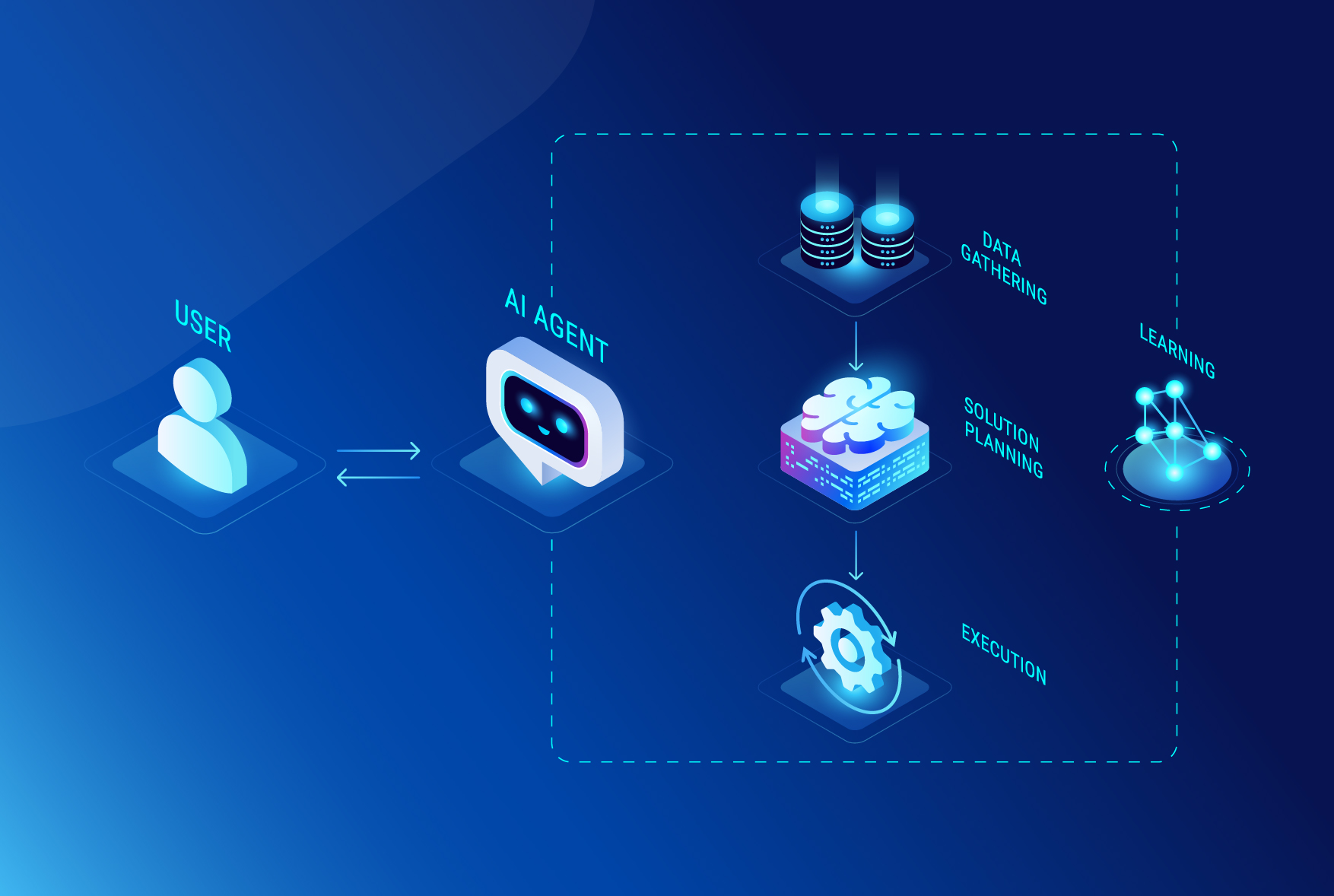
A learning agent in artificial intelligence improves its performance over time through experience. Rather than operating purely on pre-defined rules or static knowledge, a learning agent in AI updates its behavior based on feedback – getting better at its task as it processes more data and observes outcomes.
This is the architecture that powers the most sophisticated AI agent types in production today: fraud detection systems that continuously refine their detection models, recommendation engines that improve with every customer interaction, and customer service agents that learn from resolved tickets to improve future deflection rates.
Real-world example: A learning agent in an e-commerce platform that continuously updates its product recommendation model based on purchase data, session behavior, and return rates – with measurable improvement in conversion rates month over month.
How These Types Map to Real Deployment Tiers
In practice, most commercial AI agents don’t fit neatly into a single academic category – they combine characteristics from several types depending on what the use case demands. Here’s a practical mapping of agent types in artificial intelligence to deployment tiers:
| Deployment Tier | Dominant Agent Architecture |
|---|---|
| Rule-Based Chatbot | Simple reflex agent – pattern match, respond, no memory |
| LLM-Powered Task Agent | Model-based + goal-based – context-aware, multi-step task execution |
| RAG Knowledge Agent | Knowledge-based agent – retrieves from proprietary data before responding |
| Intelligent Virtual Agent (enterprise) | Utility-based + learning – optimizes across objectives, improves over time |
| Multi-Agent AI System | All types coordinated – specialized agents collaborating via orchestration layer |
Understanding this taxonomy matters for vendor evaluation. When a vendor describes their product as an ‘AI agent,’ it’s worth asking: which type of AI agent is this? What does it perceive? How does it make decisions? Does it learn? Does it plan? These questions separate genuine intelligent agent capabilities from rebranded automation.
AI Agents Examples Across Industries
- Banking: A model-based conversational AI agent handles mortgage pre-qualification, maintaining state across a multi-session customer interaction while integrating with credit bureau APIs and underwriting rules.
- Legal: A knowledge-based agent in AI surfaces relevant case law and precedent in seconds, reducing attorney research time by 60-80% in documented deployments.
- Healthcare: Intelligent virtual agents in clinical settings give physicians real-time access to treatment protocol databases, with every response grounded in HIPAA-compliant, institution-approved sources.
- Recruiting: A goal-based AI agent automates multi-step candidate screening: parsing resumes, scoring against role criteria, and drafting personalized outreach – compressing days of work into hours.
A Readiness Check Before You Invest
Before selecting an agent tier, run through four questions:
- Data quality: Is your data in a usable state? AI is only as good as what you feed it.
- Use case clarity: Can you name a specific workflow this agent will change – with a measurable target?
- Operational ownership: Who owns this after launch? Someone needs to own monitoring, maintenance, and improvement.
- Success metrics: What does success look like in 6 months? Define KPIs before you build.
If you can answer all four clearly, you’re ready to invest. If you can’t, build that organizational clarity first – it’s worth more than any technology decision you’ll make.
Up Next · Part 2 covers the AI model landscape – GPT, Claude, Gemini, and the open-source alternatives – including how to choose the right engine for your AI agent and what ‘build your own LLM’ actually means for enterprise organizations.
